
Pickleball and Racquet Sport Injuries in Ajax
A head-to-toe look at common pickleball and tennis injuries, when Ajax players may be sent for an X-ray or ultrasound, and when to seek urgent care.
· 9 min read
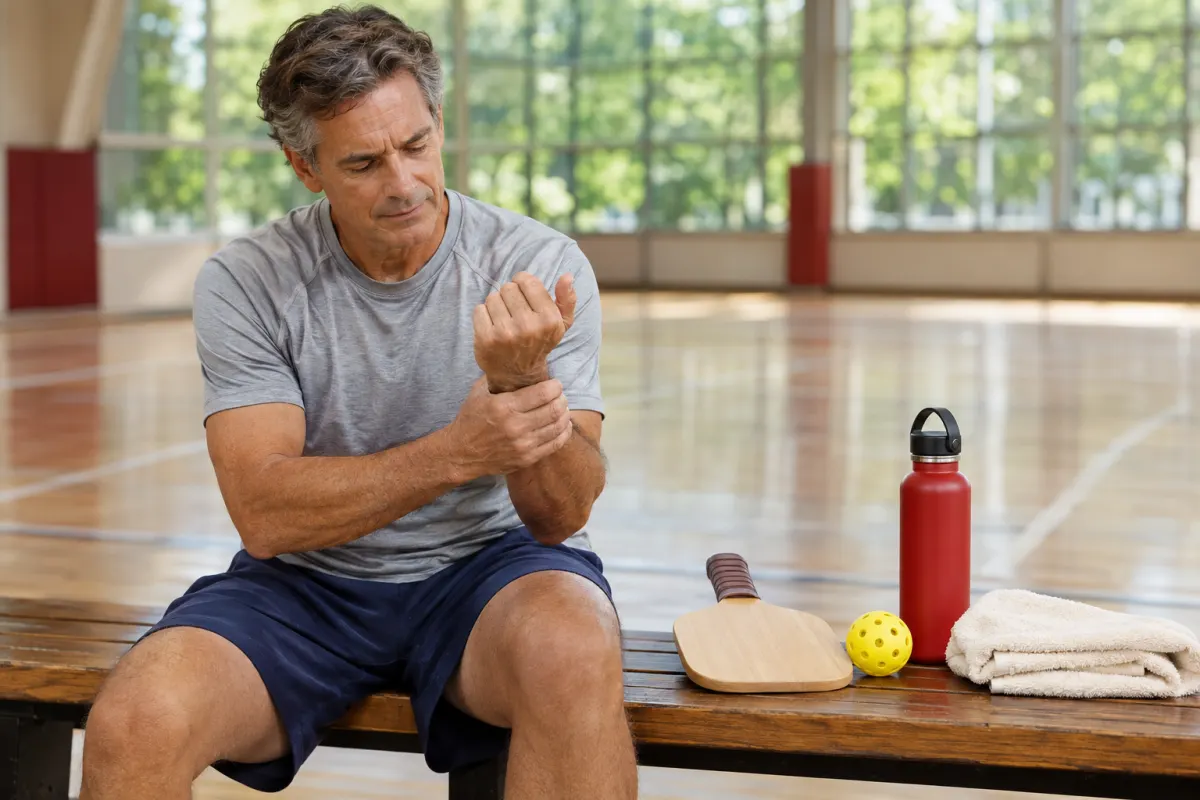
Walk past almost any community gym or outdoor court in Durham Region on a weekday morning and you will hear it: the hollow pock of a paddle meeting a plastic ball, followed by laughter and a call of the score. Pickleball has drawn in people of every age and fitness level, from retirees picking up a racquet for the first time in decades to parents squeezing in a game before work. Tennis, badminton, squash and table tennis keep their loyal crowds too.
That popularity has a side effect that physiotherapists, family doctors and imaging clinics have all noticed. More people playing quick, stop-and-start racquet games means more sprained ankles, sore elbows, strained calves and wrists landed on awkwardly after a backward stumble. Most of these injuries settle with time and sensible care. Some need a closer look.
This article takes a head-to-toe tour of the injuries most often linked with pickleball and other racquet sports, and explains in general terms when a health-care provider might send a player from Ajax, Pickering or Whitby for an ultrasound or an X-ray. It is information, not a diagnosis. If you are hurt, your provider is the person to assess you.
Why racquet sports are hard on the body
Pickleball looks gentle. The court is small, the ball is light and the pace is often social. But the movements involved are demanding in specific ways:
- Short, sharp direction changes. Lunging sideways, stopping and reversing puts sudden load through ankles, knees and calves.
- Backpedalling. Retreating for a lob is one of the most common set-ups for a fall, because people move backwards without seeing where they are going and land on an outstretched hand or on the hip.
- Repetitive gripping and swinging. Thousands of strokes ask a lot of the tendons around the elbow, wrist and shoulder.
- Hard surfaces. Indoor gym floors and outdoor courts are unforgiving when you land.
- Enthusiasm outpacing conditioning. Many players are newer to sport, returning after years away, or playing several sessions a week soon after starting.
None of this is a reason not to play. It simply explains why certain injuries keep turning up.
A head-to-toe tour of common injuries
Ankles and feet
Rolled ankles are among the most familiar racquet sport injuries. A quick lateral step lands on the edge of the foot and the ankle turns inward. Most are ligament sprains, but some involve a fracture, and the two can feel surprisingly similar in the first day or two. Our post on telling a fracture from a sprain explains how providers decide whether an X-ray is needed, so we will not repeat it here.
Heel pain that builds over weeks, rather than starting with a single twist, is a different story. Our article on foot and heel pain covers that pattern.
The calf and Achilles tendon
Players sometimes describe feeling as though someone kicked them in the back of the lower leg or hit it with a ball, then turn around to find nobody there. That sudden sensation during a push-off can come from a calf muscle strain or from the Achilles tendon. The distinction matters, and ultrasound is often useful for looking at both muscle and tendon. Our post on Achilles tendon injuries goes through the tendon in detail, including the warning signs of a complete rupture that need same-day emergency assessment.
For the calf muscle itself, ultrasound can help show where a strain is and how extensive it appears, which may help your provider plan your return to play.
Knees
Twisting on a planted foot, or deep lunges to reach low balls, can irritate or injure structures in and around the knee. Kneecap pain, tendon pain just below the kneecap, and ligament or cartilage injuries all come up in racquet players. Which test, if any, is useful depends on the suspected problem. Our post on knee pain and choosing between X-ray and ultrasound sets out how the two tests differ for the knee.
Hips and lower back
Repeated rotation and bending, often with a stiff back, can leave players with aching hips or a sore lower back. Most back pain from sport is muscular and improves without imaging. A fall backwards onto the hip is different, particularly for older players, and needs prompt assessment if you cannot bear weight.
Wrists and hands
The backward stumble described above often ends with a hand thrown out to break the fall. That fall on an outstretched hand can injure the wrist bones, including small bones that do not always show obvious deformity. If your wrist is swollen, painful to move or tender at the base of the thumb after a fall, see a health-care provider rather than waiting to see if it settles. X-ray is usually the first imaging test for suspected wrist fractures; our hand and wrist X-ray guide explains what to expect.
Players sometimes also develop pain from gripping, including at the base of the thumb or along the tendons of the wrist. Ultrasound can be a helpful way to look at tendons in this area when a provider requests it.
Elbows
Despite the name, “tennis elbow” turns up far more often in people who have never played tennis, but racquet sports are certainly one cause. Pickleball players can develop pain at the outer elbow from repetitive backhands and gripping. We have a whole article on tennis and golfer’s elbow and the role of ultrasound, which covers how the scan looks at the tendon attachments.
Shoulders
Overhead smashes and serves load the rotator cuff, the group of tendons that stabilize the shoulder. Pain reaching overhead, pain lying on that side at night or weakness lifting the arm are common reasons people mention their shoulder to a provider. Our post on rotator cuff ultrasound walks through that exam.
Eyes and head
Less common but worth mentioning: a ball to the eye or a collision with a partner can cause injuries that need urgent care. Any change in vision after a blow to the eye, or symptoms of concussion after a head knock, should be assessed promptly and not managed at home.
X-ray or ultrasound: the general pattern
Your health-care provider will choose the test, but the general logic is fairly consistent across sports injuries:
| If the question is mainly about… | The test often considered first is… |
|---|---|
| A possible broken bone after a fall or twist | X-ray |
| Bone alignment or healing over time | X-ray |
| A tendon, such as the Achilles, rotator cuff or elbow tendons | Ultrasound |
| A muscle strain or tear, such as the calf | Ultrasound |
| Fluid or swelling around a joint or tendon | Ultrasound |
Sometimes both tests are useful, and sometimes neither is needed because a clinical examination answers the question. Some injuries need other types of imaging that we do not offer, and your provider will arrange those elsewhere if needed.
At Rossland Diagnostic Clinic, digital X-ray is available on a walk-in basis; it is a good idea to call ahead for live availability, because walk-in X-ray may close for the day once capacity is reached. Ultrasound is booked by appointment.
When a racquet sport injury needs urgent care
Most court injuries are not emergencies. Some are. Call 911 or go to the nearest emergency department if, after an injury or during play, you have:
- Chest pain, chest pressure, unusual shortness of breath, fainting or a racing or irregular heartbeat. Racquet sports are vigorous, and heart symptoms during exercise should never be walked off.
- An obvious deformity, a bone through the skin, or a limb that is cold, pale or numb.
- Inability to bear weight after a fall onto the hip, especially in older adults.
- A head injury with confusion, vomiting, worsening headache, drowsiness or loss of consciousness.
- A sudden change in vision after a blow to the eye.
A community imaging clinic is not set up for emergencies. For injuries that are painful but not urgent, contact your family doctor, nurse practitioner or a walk-in clinic for assessment.
Easing back onto the court
Imaging is one piece of recovery, not the whole of it. Once a provider has assessed your injury, the plan back to play is theirs to shape with you, often alongside a physiotherapist. A few general points tend to come up:
- Pain is information. Playing through sharp or worsening pain often prolongs an injury.
- Gradual return beats a big comeback. Shorter sessions and fewer games per week at first are common advice.
- Equipment and footwear matter. Court shoes with lateral support are designed for side-to-side movement in a way running shoes are not. A paddle grip that suits your hand size may ease strain on the forearm.
- Warm-ups are not optional. A few minutes of gentle movement before competitive play prepares tendons and muscles for quick changes of direction.
- Be honest about backpedalling. Many players find it safer to let a deep lob go, or to turn and move rather than shuffling backwards.
Common questions from players
Do I need a referral for an ultrasound of a sports injury?
Ultrasound is booked with a requisition from your health-care provider, who will specify the area and the question. Bring your health card to the appointment.
Can I walk in for an X-ray after a fall on the court?
Walk-in X-ray is available at our Ajax clinic during opening hours. Please call ahead for live availability, and call the clinic to confirm what paperwork you need to bring.
My injury is weeks old. Is it too late for imaging?
Not necessarily. Some imaging is useful well after an injury, particularly when pain is not settling. Your provider will decide whether it is worthwhile.
Will the ultrasound hurt?
The scan uses a smooth probe and gel. Pressure over a sore tendon can be uncomfortable for a moment, and the sonographer may ask you to move the joint, but most people find it very manageable. Let the sonographer know if something is too painful.
Can I get copies of my images for my physiotherapist?
Images can be provided on CD when needed. Our post on getting copies of your imaging has details.
Imaging for players in Ajax
Rossland Diagnostic Clinic is at Unit 102, 300 Rossland Road East in Ajax, with free parking and ground-floor access, which helps when you are limping in from the car. We are open Monday to Friday from 9:00am to 5:00pm and Saturday from 8:00am to 3:30pm.
If your provider has requested an ultrasound or X-ray for a racquet sport injury, call 905-426-3111 or request an appointment, and we will help you get back to the game with the information your provider needs.