
Heart Testing in Ajax: Echocardiograms, Stress Tests and Monitors
A plain guide to the heart tests Durham Cardiology offers in Ajax, from EKGs and echocardiograms to stress tests and Holter monitors, and how to prepare.
· 8 min read
If you have chest pain, pressure or tightness, shortness of breath, or any other symptoms that could be a heart attack, call 911 now. Do not drive yourself to a clinic or wait for a scheduled test. Outpatient heart testing is for planned assessment that your health-care provider has arranged, not for emergencies.
With that said, many people in Ajax, Pickering and Whitby are referred for heart tests every year for reasons that are not urgent at all. A family doctor may want a baseline before a new medication, a closer look at a heart murmur heard during a routine visit, or more information about palpitations that come and go. Receiving a requisition with an unfamiliar test name on it can still feel unsettling. Knowing what each test involves, how long it takes and how to get ready usually helps.
This guide covers the six tests offered by Durham Cardiology, the cardiology team at Rossland Diagnostic Clinic in Ajax. It describes each one in plain language, using the information our team provides to patients. It is not medical advice, and your provider is the person who decides which test is right for you.
Why heart testing is ordered
Heart tests look at different aspects of how the heart works. Broadly, they fall into a few groups:
- Electrical activity: the rhythm and timing of each heartbeat
- Structure and movement: the size of the heart, its walls, its valves and how blood moves through it
- Response to activity: how the heart performs when it is asked to work harder
- Blood flow to the heart muscle: how well the muscle itself is supplied with blood
A provider chooses a test, or a combination of tests, based on your symptoms, history and examination. One test is not “better” than another; each answers a different question. If you are curious why a particular test was chosen for you, the person who ordered it is the best one to explain.
The quick, resting tests
Electrocardiogram (EKG)
An electrocardiogram measures and records the electrical activity of your heart muscle. Small sensors are placed on your skin to capture the rhythm. The test is quick, painless and does not place any stress on the heart.
- Time: about five to ten minutes
- Preparation: bring your signed requisition and valid OHIP card; no other special preparation is usually required
For many people, an EKG is the most familiar heart test, and it is often the simplest place to start.
Echocardiogram
An echocardiogram is an ultrasound of the heart. Specifically, a transthoracic echocardiogram uses sound waves to create moving images of your heart. A sonographer places an ultrasound probe on your chest, which allows your cardiologist to evaluate heart size, composition, blood flow and valve function.
- Time: approximately one hour
- Preparation: bring your signed requisition and valid OHIP card, arrive 15 minutes early, wear comfortable clothing, and do not apply cream or lotion to your upper body on the day of your test
Because it uses ultrasound rather than radiation, an echocardiogram is similar in principle to other ultrasound exams. If you have had a vascular ultrasound to look at blood flow in the arteries or veins, some parts of the experience, such as the gel and the probe, will feel familiar.
Tests that involve exercise
Some questions about the heart are best answered while it is working harder. That is the idea behind exercise testing.
Stress test
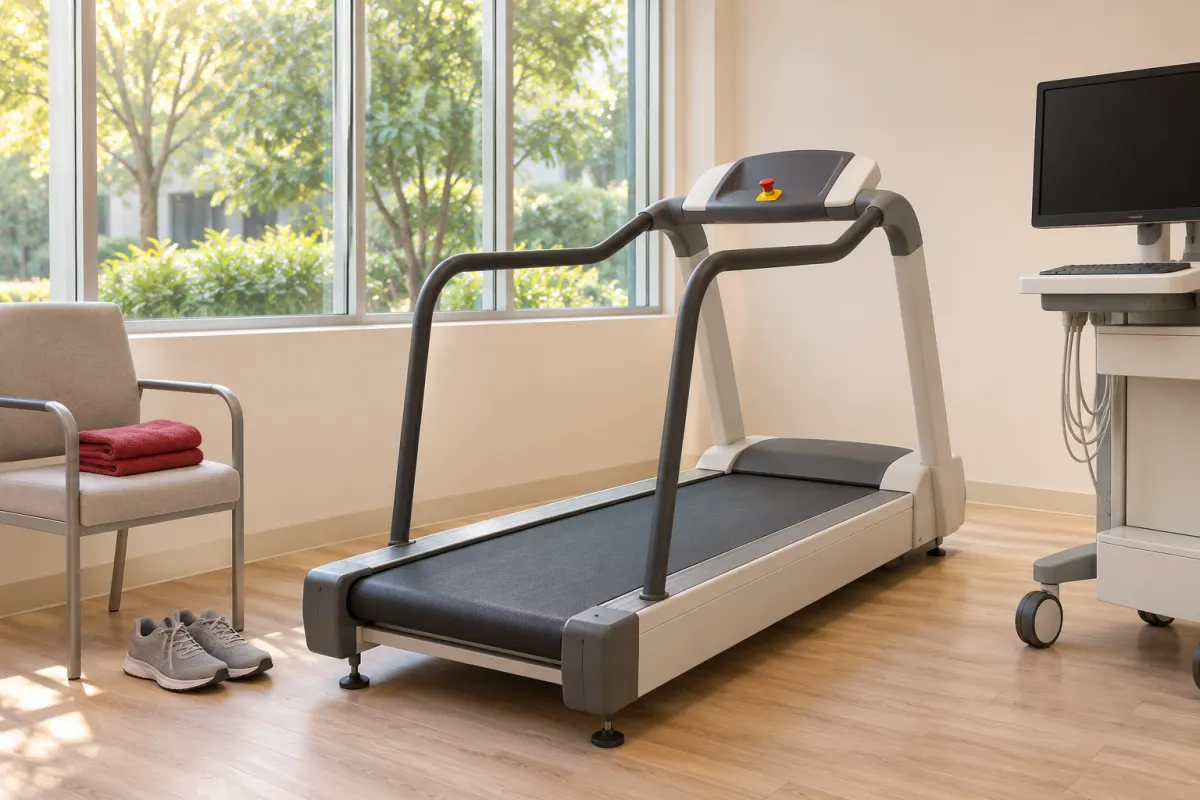
A stress test uses monitored treadmill exercise to evaluate how your heart responds to activity. It can help evaluate coronary artery disease, exercise-induced abnormal heart rhythms and exercise capacity. Electrodes are placed on your chest and connected to monitoring equipment. After a resting EKG and blood-pressure reading, the treadmill gradually increases in speed and incline.
- Time: about 30 minutes
- Preparation: bring your signed requisition, valid OHIP card and a current medication list; arrive 15 minutes early; wear comfortable clothing and running shoes; avoid cream or lotion on your upper body
Stress echocardiogram
A stress echocardiogram combines the two ideas above. A sonographer records ultrasound images of your heart’s structure, blood flow and valve function before and after activity on a treadmill.
- Time: allow approximately 60 to 90 minutes
- Preparation: the same as a stress test, including running shoes, comfortable clothing, no upper-body lotion and a list of your current medications
A note about medications
If you take a beta blocker, such as bisoprolol, atenolol or metoprolol, ask your referring physician whether you should stop it before an exercise test. For a stress echocardiogram, that question relates to the 48 hours before the test. Never stop any medication without your doctor’s approval. Your physician knows your full health picture and will tell you what is safe.
Monitoring over several days: Holter monitors
Some heart rhythm changes come and go, so they may not appear during a short test in the clinic. A Holter monitor is a portable device that records your heart rhythm while you go about your normal life, awake and asleep. The recording helps your doctor understand intermittent changes in the heart’s electrical activity over an extended period.
Durham Cardiology offers Holter monitoring for 48 hours, 72 hours or 7 days, depending on what your provider has ordered.
What to expect:
- You arrive about 15 minutes early, wearing comfortable clothing and no cream or lotion on your upper body.
- A team member fits the monitor, which takes about 15 minutes, and explains how to use your specific device.
- You go home and continue your usual routine while the monitor records.
- At the end of the prescribed period, you return the monitor to the clinic.
One practical point: showering is typically not permitted while wearing a 48-hour device. Our team will go over the details for your monitor when you are fitted, so you know what to expect before you leave.
Nuclear imaging: myocardial perfusion imaging (MPI)
Myocardial perfusion imaging is a nuclear cardiology test that shows how well blood flows through the heart muscle. It uses a small amount of radioactive tracer and a specialized camera to create images. Images may be taken at rest and during stress, which can be brought on either by exercise or by medication, depending on the test your physician ordered.
Because there are several ways of performing MPI, preparation and appointment length vary by testing protocol. Our clinic team provides your specific instructions when your appointment is confirmed, and confirms the expected timing at the same time.
Before an MPI, tell your health-care team:
- About all medications you take
- If you are pregnant, may be pregnant or are breastfeeding
As with every other test, do not stop any medication unless your physician instructs you to do so.
The tests at a glance
| Test | What it looks at | Typical time |
|---|---|---|
| Electrocardiogram (EKG) | Electrical activity of the heart | 5–10 minutes |
| Echocardiogram | Structure, valves and blood flow, using ultrasound | About 1 hour |
| Stress test | How the heart responds to treadmill exercise | About 30 minutes |
| Stress echocardiogram | Ultrasound images before and after treadmill exercise | 60–90 minutes |
| Holter monitor | Heart rhythm over 48 hours, 72 hours or 7 days | 15-minute fitting |
| Myocardial perfusion imaging | Blood flow through the heart muscle | Varies by protocol |
Getting ready: the common threads
Each test has its own instructions, but a few habits apply to almost every visit to Durham Cardiology in Ajax:
- Bring your signed requisition. Cardiac tests need a requisition from your provider.
- Bring your valid OHIP card for registration.
- Bring a list of current medications, particularly for exercise and nuclear tests.
- Arrive about 15 minutes early.
- Skip creams and lotions on your upper body, because sensors and ultrasound gel need clean skin.
- Dress for the test. Comfortable clothing for everything, plus running shoes for treadmill tests.
If anything on your requisition or instructions is unclear, call before your appointment. It is much easier to sort out a question by phone than on the day.
It can also help to write down any symptoms you have noticed, such as when palpitations happen or what activity brings on breathlessness, along with when they started. Your provider uses that information alongside the test results, and having it on paper means you will not forget details in the moment. For Holter monitoring in particular, your team may explain how to note symptoms while you wear the device, so follow the instructions you are given.
Questions people often ask
Will a heart test hurt? The tests described here are generally not painful. EKGs and echocardiograms involve sensors or an ultrasound probe on the skin. Exercise tests ask you to walk on a treadmill, which can feel like a workout, and the staff monitor you throughout.
Do I need a referral? Yes. Durham Cardiology tests are performed with a signed requisition from your provider. Referring physicians can download the cardiology requisition from the Durham Cardiology page.
Who explains my results? Your results go to the physician who ordered the test, and they discuss what the findings mean for you and any next steps.
What if my symptoms get worse before the appointment? Do not wait for your scheduled test. Contact your health-care provider, and for chest pain or other possible heart-attack symptoms, call 911.
Booking a heart test in Ajax
If your provider has given you a requisition for a cardiac test, Durham Cardiology can help. Call us at 905-426-3111, or request an appointment and our team will contact you to confirm availability. We are at Unit 102, 300 Rossland Road East in Ajax, with free parking and ground-floor access.