
Hand and Wrist X-Rays in Ajax: A Practical Guide
A practical guide for Ajax patients having a hand, finger or wrist X-ray: why it is ordered, which views are taken, what to remove beforehand and what follows.
· 8 min read
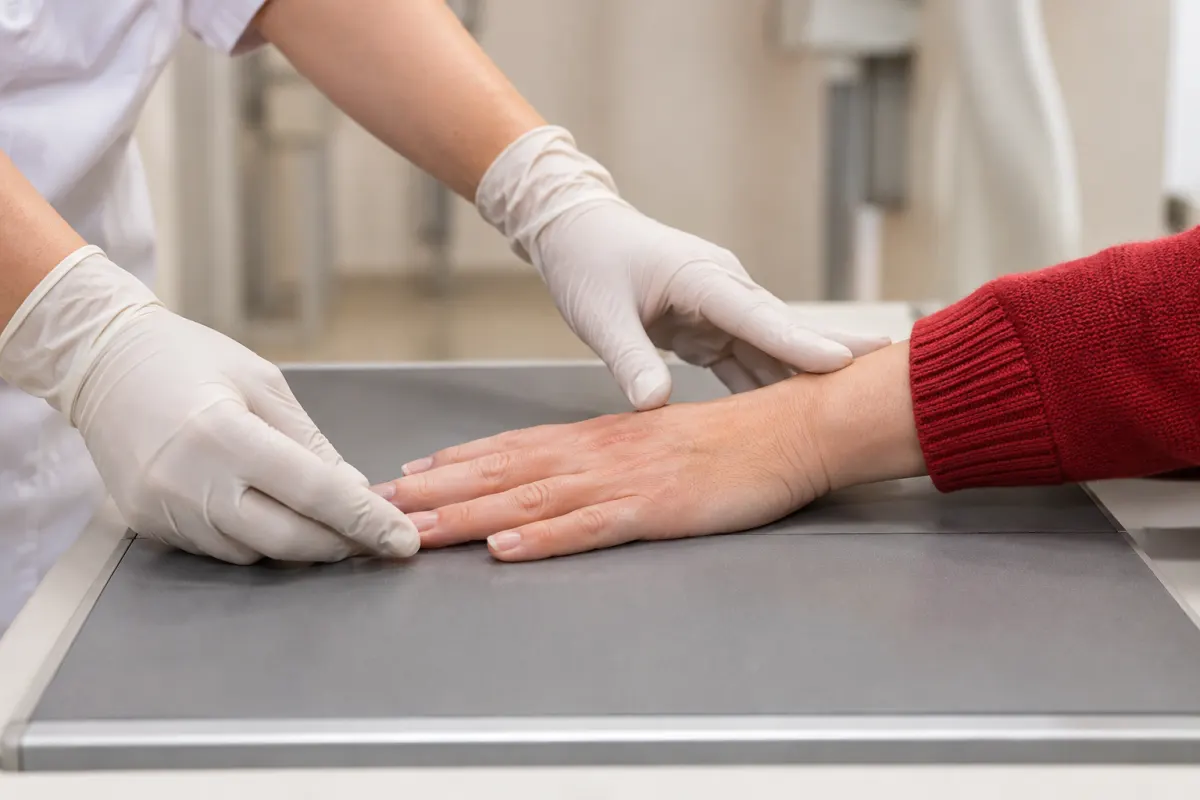
The hand and wrist contain a remarkable number of bones packed into a small space: eight small carpal bones at the wrist, five long bones across the palm, and fourteen finger bones, plus the ends of the two forearm bones. That crowded design gives us fine control for writing, cooking and holding a coffee cup, but it also means a single X-ray picture rarely tells the whole story. Hand and wrist X-rays are usually a set of carefully angled images rather than one snapshot.
This guide is a practical walk-through for people in Ajax and neighbouring communities who have been asked to get a hand, finger or wrist X-ray. It covers the reasons providers order these images, how to get ready, what the technologist will ask you to do, and how the results make their way back to you. If you are still trying to work out whether an injury might be a break or a sprain, start with our article on how X-rays help tell a fracture from a sprain, which covers that question in depth.
Reasons a provider might order hand or wrist images
Injury is the most familiar reason, but it is far from the only one. A provider may request a hand or wrist X-ray to:
- Look for a fracture or dislocation after a fall, a sports injury or a crush injury
- Check the position of bones after a fracture has been treated, to see how healing is progressing
- Assess joint changes in someone with stiffness, swelling or deformity of the knuckles
- Look for a small foreign object that may be visible on X-ray, such as a fragment of metal or glass
- Investigate a lump or persistent pain where bone involvement is a question
- Compare one hand with the other when changes are subtle
Some of these needs overlap with other tests. Soft tissue structures such as tendons, the median nerve and ganglion cysts are better seen with ultrasound, which is explained in our post on carpal tunnel and wrist ultrasound. Joint changes from arthritis are covered in more detail in what X-rays can show about arthritis.
Before you leave home: a short checklist
A hand or wrist X-ray needs very little preparation, but a few small steps can save time on the day.
- Plan for your rings. Rings, bracelets and watches need to come off, because metal blocks X-rays and can hide the bone underneath. If a ring will not come off because your finger is swollen, do not force it. Tell the technologist when you arrive. In some situations a stuck ring needs to be removed by a health-care provider before imaging, so if swelling is significant, ask your provider about this before your visit.
- Wear easy sleeves. A short-sleeved top or loose sleeves that slide up past the elbow make positioning simpler, especially for wrist and forearm views.
- Bring the paperwork you have. Your health card and any requisition from your provider. If you have questions about what documents are needed for a walk-in X-ray, call the clinic to confirm before you come.
- Bring your splint or sling if you were given one. The technologist will tell you whether it can stay on for the images. Some splints are fine to image through; others need to come off briefly.
- Check availability. Walk-in X-ray at our clinic runs during opening hours, but the department may close to new walk-ins once daily capacity is reached. A quick call to 905-426-3111 lets you know whether now is a good time.
- Think about the drive. If your dominant hand is injured, driving may be unsafe or uncomfortable. Arranging a ride is often the better choice.
Understanding the views
One thing that surprises people is how many pictures are taken of something as small as a hand. There is a good reason. Bones overlap each other, especially at the wrist, and a fracture line that is invisible from one direction can be obvious from another. Typical series include:
Hand
Usually a picture with the palm flat on the detector, an angled view with the hand tilted partway onto its side, and sometimes a side view with the fingers fanned so they do not overlap.
Wrist
Commonly a front view with the palm down, a side view with the thumb up, and an angled view. Depending on the question, the provider may request additional images. A provider concerned about the scaphoid, a small bone at the base of the thumb, may ask for specific scaphoid views, where the wrist is angled in a particular way to show that bone more clearly.
Fingers and thumb
Individual fingers or the thumb can be imaged on their own, with the other fingers moved out of the way. This gives a clearer look at the small joints.
The exact views depend on what your provider writes on the requisition and on the radiology department’s protocols. You do not need to know which ones you are getting, but it may help to understand why the technologist asks you to move your hand several times.
During the exam, step by step
Here is what a typical hand or wrist X-ray at our clinic looks like from your side of the table.
- Check-in. You give your health card and paperwork at reception. You will be asked to confirm your details.
- Into the X-ray room. You will usually sit on a chair or stool beside the X-ray table, rather than lying down. Your arm rests on the table surface.
- Removing metal. Jewellery and watches come off. Anything else with metal near your arm, such as a bracelet-style medical alert, will also be set aside safely.
- Pregnancy question. If there is any possibility you are pregnant, tell the technologist before the first picture. Hand and wrist X-rays are far from the abdomen, but the technologist still needs to know.
- Positioning. The technologist will place your hand flat, tilted or on its side, and may use foam pads or sponges to hold the position comfortably. If something hurts, say so. Small adjustments can make a big difference.
- Holding still. For each image you will be asked to keep completely still for a moment. Breathing normally is fine for hand and wrist pictures.
- Repeat for each view. The technologist steps out briefly for each exposure, then returns to reposition you for the next one.
- Finished. Once the images are checked for quality, you can put your jewellery back on and leave.
The whole thing is usually brief. The exposures themselves are very quick; most of the time goes into careful positioning.
If you are in a lot of pain
An injured wrist can make the flat palm-down position difficult. Technologists are used to this and can often adapt the position, take the images in a slightly different order, or let you rest between views. Moving slowly and telling them what hurts helps them help you. If pain is severe, the hand looks clearly misshapen, the skin is broken over a possible fracture, or the fingers turn pale, cold or numb, go to an emergency department instead of a community clinic.
Radiation and the hand
Hand and wrist X-rays use a low dose of radiation, and the area being imaged is far from the body’s more sensitive organs. Modern digital equipment also helps keep exposure low. If you would like to understand more about dose and safety, including what to ask if you are pregnant, our article on X-ray radiation safety explains it in plain language.
After the X-ray
The images are interpreted and a written report is sent to the provider who ordered the exam. If an urgent finding is identified, the ordering physician is alerted. Your provider is the person who will go over the results with you and decide on next steps, whether that is a splint, a referral, a follow-up X-ray or no further imaging at all.
If you need a copy of your images, for example to take to a specialist appointment, they can be provided on CD when needed. Ask the reception team about this when you check in.
Follow-up X-rays are normal
People are sometimes surprised to be sent back for a second X-ray of the same wrist a week or two later. This is common practice for certain injuries. Some fractures are hard to see on the first images and become clearer as healing begins, and healing fractures are often rechecked to make sure the bones are staying in a good position. A repeat image is not a sign that something was missed or went wrong.
Common questions
Can I have my X-ray with a cast on? Sometimes, yes. Casts and some splints can be imaged through, although they can make the picture less sharp. Your provider will specify on the requisition, and the technologist will tell you what to do on the day.
Do I need to fast or avoid anything beforehand? No. There is no food, drink or medication preparation for a hand or wrist X-ray.
Will both hands be X-rayed? Only if your provider requests it. For some joint conditions, both hands are imaged so they can be compared.
Can someone come into the room with me? Whether a companion can stay in the X-ray room depends on the situation. If you are hoping to bring someone in with you, call the clinic to confirm before your visit.
Can I walk in on a Saturday? Walk-in X-ray is available on Saturdays from 8:00am to 3:30pm, subject to daily capacity. Calling ahead is recommended.
Visiting the clinic
Rossland Diagnostic Clinic is at Unit 102, 300 Rossland Road East, Ajax, with free parking and ground-floor access. We are open Monday to Friday from 9:00am to 5:00pm and Saturday from 8:00am to 3:30pm. Patients come from across Ajax, Pickering, Whitby and beyond.
Read more on our X-ray service page, call 905-426-3111 for live walk-in availability, or request an appointment for other services such as ultrasound. We will do our best to make your visit quick and comfortable.