Exercise for Stronger Bones: A Guide for Ajax Residents
Which kinds of exercise give bones a useful challenge, how to start safely at any fitness level, and how Ajax residents can keep moving through winter.
· 9 min read
Is it possible to exercise in a way that matters to your skeleton, not just your heart, waistline or mood? For most people, the answer is yes, but the kind of exercise that helps bone is a little more specific than “stay active.” A gentle stroll is good for you in many ways. A swim is wonderful for the joints. Neither one asks very much of your bones, though, and bone is a tissue that tends to respond to being asked.
This guide is for Ajax residents who want to understand what “bone-friendly” exercise really means and how to fit it into ordinary life. We have already covered the broader habits of osteoporosis prevention and the balance work that helps in preventing falls and fractures, so here we focus on the principles behind training for bone, how to start from wherever you are, and how to keep going through a Durham Region winter.
As always, this is general information. Your doctor, nurse practitioner or a physiotherapist can tell you what is safe for your own body, especially if you already have low bone density, a past fracture, heart or lung problems, or joint pain.
Bone is living tissue that keeps score
It is easy to think of the skeleton as scaffolding: fixed, finished and inert. In reality, bone is constantly being broken down and rebuilt in small amounts throughout life. Cells that remove old bone and cells that lay down new bone work in a slow, ongoing cycle.
What tips that cycle in a helpful direction? One of the strongest signals is mechanical strain: the slight bending and compression that happens when muscles pull on bone or when bone absorbs force from the ground. When bone experiences loads that are a bit more than it is used to, it tends to adapt. When it experiences very little load for a long time, as during prolonged bed rest, it tends to lose mass.
Three features of exercise seem to matter most for that signal:
- Load. How much force the bone experiences.
- Novelty. Bone appears to respond better to forces that are different from its everyday routine.
- Consistency. Like muscle, bone responds to repeated stimulus over months, not to a single heroic session.
You do not need to memorize the biology. The practical takeaway is that bone-friendly exercise involves some form of resistance or impact, progresses gradually, and happens regularly.
The three families of bone-friendly movement
Rather than listing dozens of exercises, it helps to think in categories. A well-rounded routine usually draws from all three.
Resistance: making muscles pull
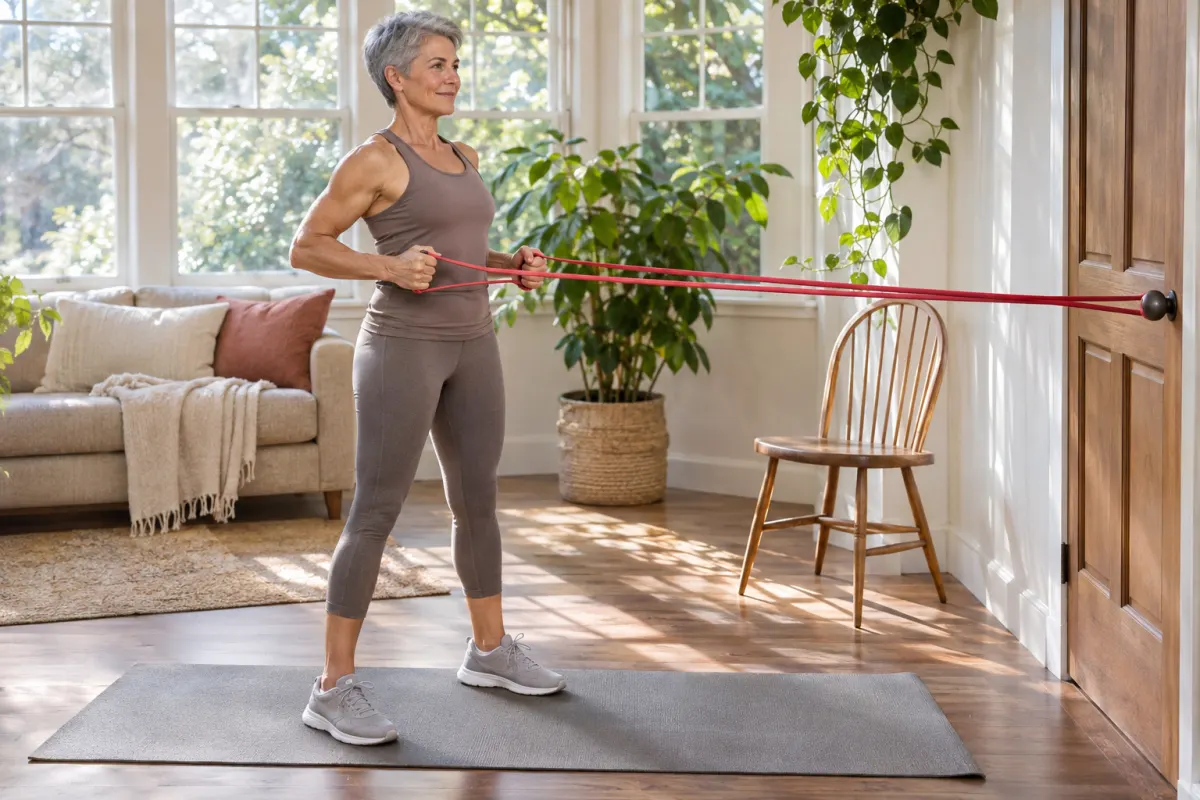
Muscles attach to bone through tendons. When a muscle contracts hard against resistance, it tugs on the bone, which is one of the ways bone receives its signal. Resistance can come from free weights, machines, resistance bands, or your own body weight. The important part is that the effort feels genuinely challenging by the last few repetitions, while your form stays controlled.
Impact: meeting the ground
Activities where your feet strike the ground send a brief force up through the legs, hips and spine. Impact ranges widely, from the gentle loading of marching on the spot, through stepping and stair work, to higher-impact movements like jogging, skipping or small jumps. Higher impact is not right for everyone, and some people with low bone density or joint problems are advised to avoid it. That is a conversation to have with your health-care provider.
Balance and posture: keeping the gains
Balance and posture work does not load bone much on its own, but it protects the skeleton you have. Good balance reduces the chance of a fall, and strong back and core muscles help support the spine. Think of this category as the insurance policy that sits alongside the other two.
Where are you starting from?
The right first step depends on your history. Here are four common starting points and how people often approach them, always with professional guidance where needed.
“I’m already active, but mostly cardio”
Walkers, cyclists and swimmers already have good habits, and the heart and lungs benefit greatly. The gap is usually resistance. Adding two or three short strength sessions a week, focusing on the large muscles of the legs, hips, back and arms, is a common way to round things out. Cyclists and swimmers in particular may want to add some form of weight-bearing activity, since both sports are largely non-weight-bearing.
“I haven’t exercised in years”
Start smaller than you think you should. Body-weight movements done slowly and with control, a short daily walk, and simple standing exercises near a counter are reasonable entry points for many people. The goal in the first month is not intensity; it is building the habit and learning how your body responds. A physiotherapist or a qualified trainer can be very helpful at this stage.
“I’ve been told I have low bone density or osteoporosis”
Exercise is generally still encouraged, but the details change. Some movements, particularly repeated deep forward bending of the spine, forceful twisting, or heavy lifting with a rounded back, may not be appropriate. Higher-impact activities may also be discouraged depending on your results and history. Ask your health-care provider for a referral to a physiotherapist who works with bone health, and ask them specifically which movements to avoid as well as which to include. If you want to understand what your report says, our explanation of T-scores and Z-scores may help.
“I’m recovering from a fracture”
Return to exercise after a fracture should follow the plan from your treating doctor or physiotherapist. Healing bone has its own timeline, and going too fast can set you back. Once you are cleared, the same principles apply: gradual resistance, appropriate loading and balance work, tailored to what you went through.
Building a sensible week
There is no single correct schedule, but a balanced week for a generally healthy adult often includes:
- Two or three strength sessions, on non-consecutive days, working the major muscle groups.
- Weight-bearing activity on most days, such as brisk walking, stair climbing or dancing, at a level that suits you.
- Short balance practice woven into daily life, such as while waiting for the kettle.
- Rest and recovery, which is when the body adapts.
If that sounds like a lot, remember that sessions can be short. Twenty focused minutes of strength work can be worthwhile. Breaking walking into two or three shorter bouts across the day counts too.
Progression without overdoing it
Because bone responds to load that is a bit more than usual, progression matters. Over weeks, people usually increase one thing at a time: slightly heavier resistance, a few more repetitions, or a slightly more challenging version of a movement. Increasing everything at once is a common route to soreness or injury. A good rule of thumb is that you should feel worked, not wrecked, the next day. Sharp pain, joint swelling, chest pain or shortness of breath are signals to stop and speak with a health-care provider. If you have chest pain, severe shortness of breath or feel faint during exercise, call 911.
Keeping it going through an Ajax winter
Summer is easy. The waterfront paths and neighbourhood trails make walking a pleasure. Winter is where routines fall apart, and icy sidewalks bring their own risk to bones.
A few ideas for the colder months:
- Move your walking indoors. Shopping centres, community centre tracks and even long hallways in apartment buildings can stand in for outdoor routes on slippery days.
- Keep a small home kit. A set of resistance bands, a sturdy chair and a mat are enough for a full strength routine. They take up little space and cost relatively little.
- Look into group programs. Community centres and recreation programs across Ajax, Pickering and Whitby often run strength, balance and fitness classes, including some designed for older adults. A class adds structure and company.
- Dress for the conditions. If you do walk outside, footwear with good grip and ice cleats where appropriate can reduce the risk of a fall. Our post on winter slips and falls covers what to do if one happens.
The point is not to be perfect through January and February. It is to avoid a three-month gap that undoes the habits you built.
Common misunderstandings
A few ideas come up again and again.
“I walk the dog every day, so my bones are covered.” Walking is valuable and is weight-bearing, but for many people it is not enough of a challenge to the bones on its own, especially if the pace is easy. Adding resistance work tends to round things out.
“Lifting weights is only for young people.” Strength training is widely recommended for older adults, with appropriate modifications. Starting weights can be very light.
“If I have osteoporosis, I should avoid exercise to protect my bones.” In most cases, appropriate exercise is still recommended. The key word is appropriate, which is why individual guidance matters.
“Yoga and Pilates are always bone-safe.” Many poses and exercises are excellent, but some involve deep spinal flexion or twisting that may not suit people with fragile bones. Let your instructor know about your bone health, and check with your provider.
Where a bone density scan fits in
Exercise is something nearly everyone can benefit from, but it does not tell you where your bones stand right now. A bone mineral density scan uses a low-energy X-ray to measure bone density, usually at the hip and spine. Your doctor may recommend one based on your age, health history and risk factors; it requires a referral. If you are wondering whether you are a candidate, see our post on who should get a bone density test.
Knowing your results can shape the kind of exercise your health-care provider and physiotherapist recommend. Someone with healthy bone density may be encouraged toward more impact; someone with osteoporosis may get a more tailored plan.
Key takeaways
- Bone tends to respond to load that is a bit more than usual, applied regularly and increased gradually.
- A rounded routine combines resistance, appropriate impact, and balance and posture work.
- Start from where you are, not where you think you should be, and progress one variable at a time.
- If you have low bone density or a past fracture, ask for guidance on which movements to avoid as well as which to do.
- Plan ahead for winter so the habit survives until spring.
If your doctor has referred you for a bone density scan, Rossland Diagnostic Clinic at 300 Rossland Road East in Ajax can help. Please bring your health card and requisition, skip calcium and iron supplements on the day until after your scan, and wear clothing without metal fasteners. Call 905-426-3111 or request an appointment when you are ready.