
Blood Clot Concerns in Ajax: Ultrasound and Deep Vein Thrombosis
Learn what deep vein thrombosis is, the warning signs that need emergency care, and how venous ultrasound helps doctors check for leg clots in Ajax.
· 8 min read
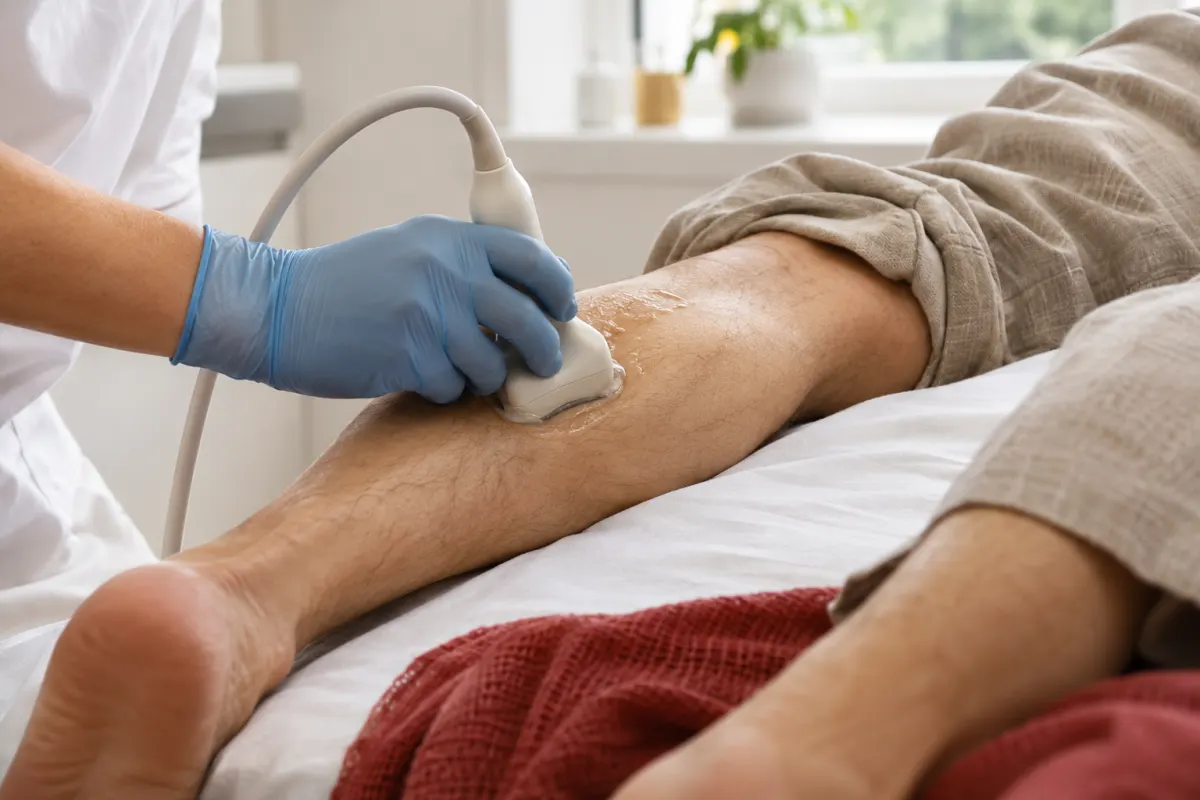
Imagine noticing that one of your calves feels tight and heavy a few days after a long drive home from a family visit. It looks a little more swollen than the other leg, and it is tender when you press on it. Maybe it is a pulled muscle. Maybe it is nothing. But the thought of a blood clot crosses your mind, and you are not sure what to do next.
This is a situation many people face, and it is one where getting the right kind of help, at the right speed, really matters. This article explains what deep vein thrombosis (DVT) is, which symptoms call for emergency care, how ultrasound is used to check for clots in the leg and what the exam is like for patients in Ajax and across Durham Region.
First, an important safety note
If you have sudden leg swelling or pain together with chest pain, shortness of breath, a racing heartbeat, coughing up blood, or feeling faint, call 911 or go to the nearest emergency department right away. These can be signs that a clot has travelled to the lungs, which is a medical emergency. Do not drive yourself, and do not wait for an imaging appointment.
Diagnostic imaging clinics, including ours, are not emergency services and are not set up to assess or treat urgent medical problems. If you have new leg symptoms that worry you but no chest or breathing symptoms, contact your doctor promptly, or go to an emergency department or urgent care centre if you cannot reach them. A clinician can decide how quickly you need to be seen and what testing is appropriate.
What deep vein thrombosis is
Your veins carry blood back toward the heart. Some veins sit close to the surface of the skin, and others run deep within the muscles of the legs, pelvis and arms. Deep vein thrombosis is a blood clot that forms in one of these deeper veins, most often in the calf or thigh.
A clot can partly or completely block blood flow through the vein. That blockage is what causes many of the typical symptoms, such as swelling and aching, as blood has difficulty draining from the limb.
The main concern with DVT is that part of a clot can break loose and travel through the bloodstream to the lungs. This is called a pulmonary embolism, and it can be serious. That is why suspected DVT is taken seriously by doctors and why symptoms should not be ignored.
Who is more likely to develop a clot
Blood clots can affect anyone, but certain situations raise the risk. Doctors often think about three broad factors: blood that is moving slowly, injury to a vessel wall and blood that clots more easily than usual. In everyday terms, some common risk factors include:
- Long periods without moving, such as extended car trips, long flights, bed rest or a hospital stay
- Recent surgery, especially surgery on the hips, knees or abdomen
- Injury to the leg, including fractures and casts
- Pregnancy and the weeks after giving birth
- Hormone-containing medications, including some forms of birth control and hormone therapy
- Cancer and some cancer treatments
- A previous blood clot or a family history of clots
- Older age, being overweight, and smoking
- Certain medical conditions, including some heart and inflammatory conditions
Having a risk factor does not mean you will develop a clot, and some people develop DVT without any obvious cause. If you are concerned about your personal risk, especially before surgery or a long trip, talk to your doctor.
Long trips and staying mobile
Many Ajax residents travel regularly, whether it is a flight out of Toronto, a drive to cottage country or a long trip to visit family. Sitting still for hours slows blood flow in the legs. General advice that is widely shared for long journeys includes getting up to walk when you can, flexing and pointing your feet and circling your ankles while seated, and drinking enough fluids. If you have had a clot before, are pregnant, have recently had surgery or have other risk factors, ask your doctor before travelling whether any extra precautions make sense for you. Only your health-care provider can advise on things like compression stockings or medication.
Symptoms that can suggest DVT
DVT symptoms usually affect one limb rather than both. They can include:
- swelling in one leg, ankle or foot, or less often in an arm
- pain, cramping or tenderness, often starting in the calf
- warmth over the affected area
- red or discoloured skin
- a feeling of heaviness or tightness
- veins near the surface that look more visible than usual
It is worth knowing that some people with DVT have mild symptoms or none at all. On the other hand, many conditions can cause similar symptoms, including muscle strains, a ruptured cyst behind the knee, skin infections and general fluid retention. Symptoms alone cannot tell the difference, which is where imaging becomes useful.
How ultrasound helps check for a clot
When a doctor suspects DVT, a venous ultrasound of the affected limb is one of the most common tests used. It is non-invasive, does not use radiation and gives real-time images of the veins and the blood moving through them.
Compression: the key technique
One of the main ways a technologist looks for a clot is surprisingly simple. A healthy vein has soft walls, and when gentle pressure is applied with the ultrasound transducer, the vein squeezes flat. A vein containing a clot typically does not compress fully, because the clot fills the space inside.
During the exam, the technologist moves step by step along the vein, pressing gently at intervals and watching whether the vein compresses.
Doppler: watching the blood move
The exam also uses Doppler ultrasound, which detects the movement of blood. Colour Doppler shows flow as colour on the screen, and spectral Doppler shows it as a waveform. Changes in the expected flow pattern can give additional clues. For a more detailed explanation of how this technology works, see our article on how blood flow imaging works.
What the images can and cannot show
A venous ultrasound can show whether a clot appears to be present in the veins examined, and where. It cannot always see every vein equally well, particularly veins deep in the pelvis or in people with significant swelling. Your doctor combines the ultrasound report with your symptoms, physical examination and sometimes blood tests to decide what it means for you.
What to expect during a leg vein ultrasound
If your doctor orders a venous ultrasound, the experience is generally straightforward.
- Getting ready. You will be asked to expose the leg being examined. Loose clothing or shorts make this easier. You may be given a gown or a sheet for privacy.
- Positioning. You will usually lie on your back on a padded exam bed, sometimes with the leg turned slightly outward and the knee a little bent. You may be asked to turn onto your side or stomach to examine the back of the knee and calf.
- The scan. Warm or room-temperature gel is applied, and the technologist moves the transducer along the inner thigh, behind the knee and down the calf, pressing gently at intervals.
- Your role. You may be asked to stay still, change position or briefly hold your breath. If a spot is tender, let the technologist know.
- Finishing up. The gel is wiped off, and you can get dressed and go about your day.
The pressure applied during compression can be uncomfortable if your leg is sore, but it is brief. Tell your technologist if you need a moment.
Preparation
Preparation for vascular studies varies, and our team will confirm any instructions when your appointment is booked. Bring your health card and requisition, and wear clothing that is easy to remove from the legs.
After the scan
The images and findings are sent to the doctor who ordered the test. Your doctor is the right person to explain the results and talk about next steps, which may include treatment, follow-up imaging or no further action. Imaging clinics do not prescribe treatment for blood clots.
While you are waiting to hear from your doctor, the same safety rule applies: if you develop chest pain, shortness of breath or any other worrying symptom, call 911 or go to the nearest emergency department.
Questions people often ask
Can I walk into the clinic for a DVT check? Our walk-in service is for digital X-ray. Vascular ultrasound is arranged by appointment, and the exam that is done is based on what your doctor has requested. If you think you have a clot and cannot reach your doctor, go to an emergency department rather than waiting for an imaging appointment.
Does the test hurt? Most people find it painless. The gentle pressure used to check whether veins compress can feel uncomfortable on a sore leg, but it lasts only a moment.
Is there any radiation? No. Ultrasound uses sound waves, not X-rays.
Can ultrasound check the arms too? Yes. Clots can sometimes form in the deep veins of the arm, for example in people who have had an intravenous line. Your doctor will specify which area needs to be examined.
Getting your ultrasound in Ajax
If your doctor has requested a vascular ultrasound and has advised that it is safe to book as an outpatient, our clinic at 300 Rossland Road East in Ajax offers free parking and ground-floor access, so you do not have far to walk on a sore leg. Patients visit us from Ajax, Pickering, Whitby and nearby communities.
To arrange your appointment, call 905-426-3111 or request a booking online. And remember: for chest pain, breathing difficulty or sudden severe symptoms, call 911 first.